
Not long ago, I had quite a dizzying experience while taking a walk with my dog, Dagom. We bumped into a rather large, unfamiliar dog at the park. Because the dog was wagging its tail vigorously, I naturally assumed it was a friendly greeting. However, the moment I stepped closer to let Dagom say hello, the dog suddenly barked and showed intense defensive behavior. I was so startled! Thankfully, we passed by without any incidents, but that day sparked a deep dive into the true meaning of dog tail wagging.
We often misunderstand dog tail wagging as a simple expression of joy. In reality, it’s much closer to complex “speech” than a human “smile.” It is a crucial communication tool that holds complicated emotions like anxiety, tension, and alertness, not just pure delight. Veterinarians explain that we must interpret a dog’s tail movements comprehensively along with other calming signals, such as overall muscle tension, gaze, and ear position. Misinterpreting a warning sign as friendliness can lead to dangerous situations where pets get hurt or frightened. Accurate interpretation is absolutely essential to keep both our own pets and others safe.
Table of Contents
The Scientific Secret Behind Dog Tail Wagging Direction
One of the most surprising facts we often miss is that there is a scientific secret hidden in the “direction” of a dog’s tail. According to researchers from the University of Trento in Italy, dogs, just like humans, have a lateralized brain where the left and right hemispheres control entirely different emotions.
Neurologically, the left hemisphere controls positive, approach-driven motivations and moves the right side of the body. Conversely, the right hemisphere controls negative, avoidance-driven motivations and affects the left side of the body. This incredible brain activity is directly reflected in the direction of their tail.
Wagging to the Right: Positivity and Bonding
Think about the moment you come home from work and your furry friend greets you, their tail swinging so hard it might fly off. If you carefully observe the direction of this movement, you’ll notice a clear pattern.

This right-sided wagging means boundless love and comfort toward you, so be sure to shower them with affection and positive interactions!
Wagging to the Left: Anxiety and Guarding
When placed in an unfamiliar environment or feeling threatened, the tail direction changes completely. That unfamiliar dog I met on my walk was highly likely wagging its tail biased to the left.
- Key Fact: When facing a stranger, a guarded dog, or a stressful situation, the tail wags predominantly to the left (from the dog’s perspective).
- Behavioral Data: Interestingly, experiments with fellow dogs showed that witnessing left-sided dog tail wagging causes their heart rate to spike and triggers immediate anxiety symptoms.
This means that even among dogs, a left-sided wag is a clear warning or sign of unease. If you see this behavior, do not force an approach. Give them distance so the dog can find peace on its own.
Decoding Dog Tail Wagging Height and Shape
Just as important as the direction is the “height” of the tail. Every breed has a different natural tail base—or neutral position—whether it’s super short like a Welsh Corgi’s or curled up over the back like a Jindo’s. The correct approach is to observe changes based on your dog’s (or the other dog’s) baseline tail height.
High and Stiff Tail: Dominance and High Alert
You’ve probably seen dogs during a walk suddenly raise their tails stiffly like an antenna when they meet another dog. This is not a simple, happy greeting.
- Key Fact: Raising the tail almost vertically is a strong warning sign meant to show off their presence and release pheromones widely.
- Warning Sign: If the tail is raised high and only the very tip is vibrating quickly and shortly, it means the dog is extremely sensitive. Their tension level is severely high, so it is best to gently control your dog and naturally leave the area.
My dog, Dagom, also occasionally raises his tail high when he meets a dominant dog. When he does, I make sure to hold the leash short and try to calm his excitement immediately.
Tail Tucked Between Legs: Extreme Fear and Tension
Whether on a vet clinic examination table or during loud noises like thunder, you can often see dogs dropping their hips and hiding their tails. It’s a posture that breaks a pet parent’s heart the most.
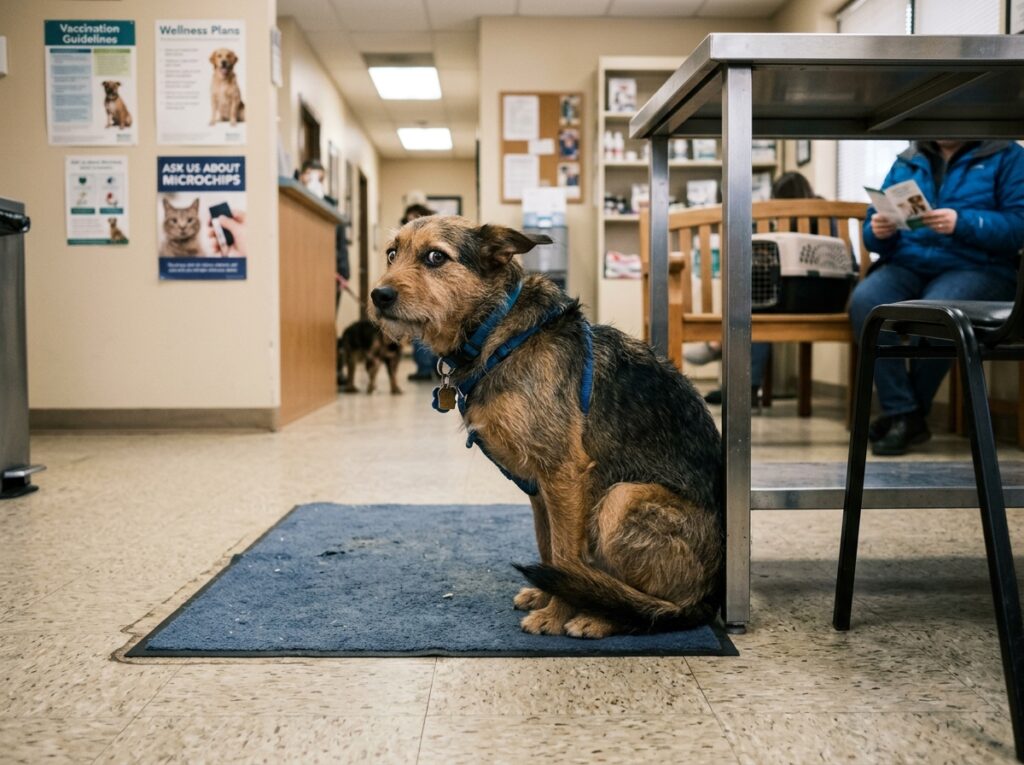
The crucial thing to note is that if you try to pet a terrified dog because they look pitiful or approach them suddenly, they might instinctively show defensive aggression to protect themselves. Giving them a quiet, safe space to calm down on their own is the best consideration you can show.
Understanding Dog Tail Wagging for a Safer Bond
So far, we’ve explored how to read a dog’s true feelings through the direction and height of their tail. Since I truly understood the hidden language of dog tail wagging, our daily walks have become so much more peaceful, and I feel our bond has deepened immensely.
The most important takeaway is the need for comprehensive judgment. A dog’s emotions cannot be entirely explained by the tail alone. You need to read the whole body language—whether the ears are pulled back, the fur on the back is standing up, or the muscles around the lips are tense—to achieve perfect communication.
One last piece of advice: If your dog consistently shows signs of anxiety, like wagging to the left or tucking their tail in front of certain places or people, avoid forcing them into those situations to “get them used to it.” Before the fear deepens, I highly recommend consulting a professional like a trainer or a veterinarian to diagnose the exact cause and begin positive behavioral correction.
When we carefully listen to our dog’s subtle body language, our happy journey as true family members is finally complete.
What kind of tail language does your dog usually use to talk to you? If your furry friends have their own lovely and special ways of expressing themselves, please share them in the comments below!