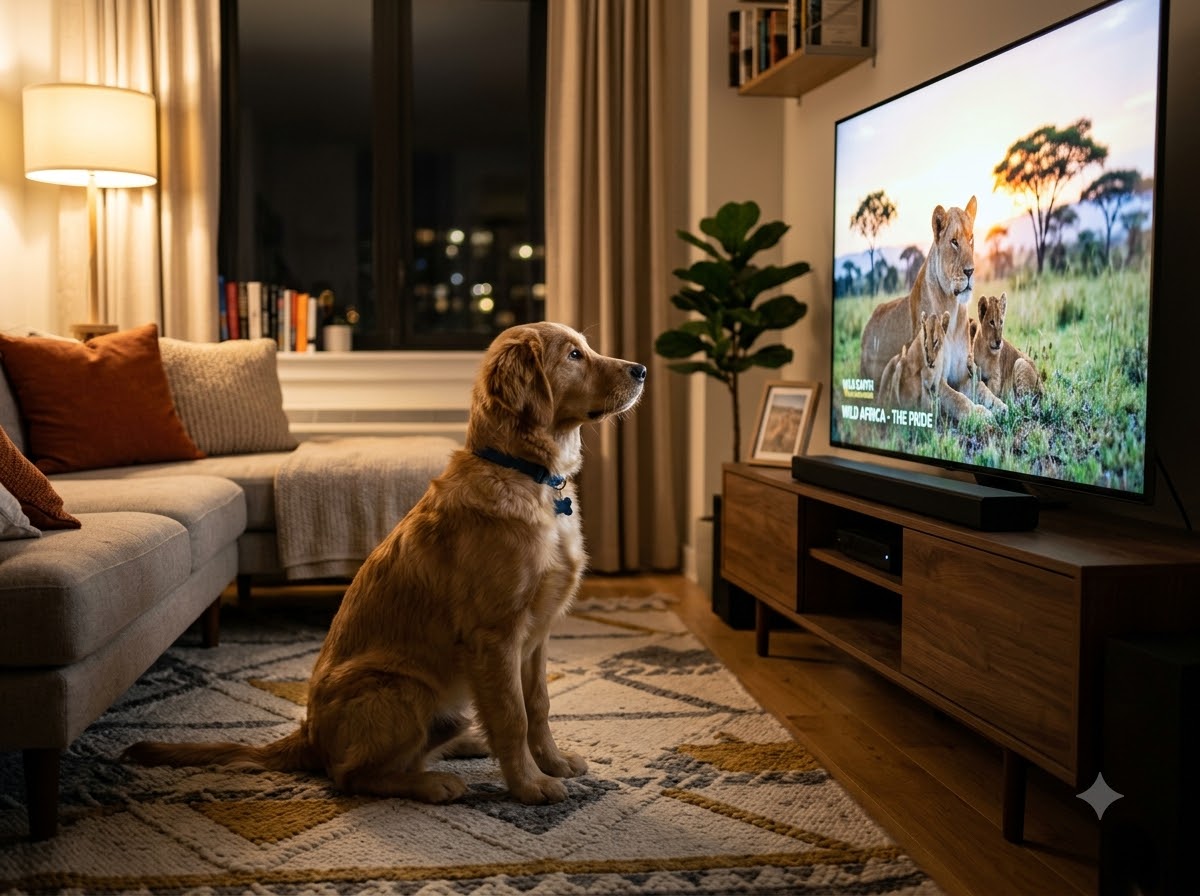
Did you know that until just a few years ago, your living room television likely looked like a rapidly flickering strobe light to your canine companion? While human eyes can process continuous motion at around 50 to 60 frames per second (Hz), our four-legged friends have significantly faster visual processing capabilities. They require a frame rate of at least 70 to 80 Hz to perceive a smooth, uninterrupted image. As someone who spends time carefully monitoring canine behavior and engagement while developing quality senior dog feed and turkey tendon treats at Greenbone, I’ve noticed firsthand how dogs react entirely differently to modern, high-refresh-rate screens compared to older displays. Today, we are diving deep into the fascinating veterinary science behind exactly how dogs see TV, exploring their unique visual mechanics and decoding the hidden meanings behind those adorable, and sometimes chaotic, screen-time habits.
Table of Contents
The Science of Canine Vision: How Dogs See TV Differently
Frame Rates (Hz) and Dynamic Visual Acuity
As mentioned, dogs have an exceptional ability to detect motion, thanks to their highly developed dynamic visual acuity. Because their eyes update images faster than ours, older 60Hz CRT televisions or early LCD models didn’t provide enough frames per second to fool a dog’s brain into seeing a continuous video. Instead, they saw a harsh, rapidly blinking sequence of images—often referred to as the flicker effect—which could cause significant visual fatigue.
Fortunately, with the widespread adoption of 120Hz or higher smart TVs (such as QLED and OLED models), modern living rooms are finally dog-friendly. On these advanced screens, how a dog sees TV is much closer to our own experience, allowing them to watch smooth, natural, and continuous movements.
Dichromatic Vision: Why Red and Green Don’t Matter
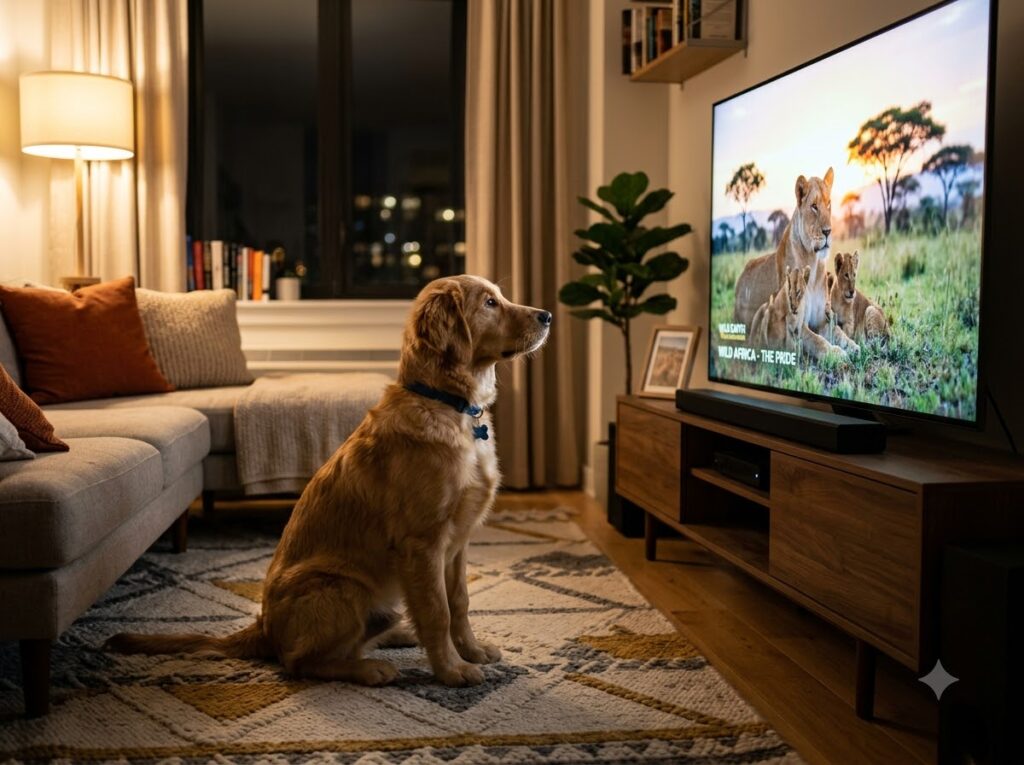
Another crucial factor in understanding how dogs see TV screens lies in their color perception. Dogs have a different cellular makeup in their retinas compared to humans; they lack the specific cone cells required to perceive red and green hues. Instead, they possess dichromatic (two-color) vision, processing the world primarily in shades of blue and yellow.
When you look at a bright red apple or lush green grass on the screen, your dog perceives it as a dark gray or muddy brown. Consequently, dogs are far less interested in a vibrant spectrum of colors and are much more captivated by high-contrast movements and content featuring distinct blue and yellow palettes. They react quickly to shifts in lighting and motion rather than the colors themselves.
Hidden Meanings Behind 3 Common ‘Dogs Watching Television’ Behaviors
1. Barking or Lunging at the Screen
When another animal appears on the screen or an object darts quickly across the frame, a dog’s rod cell-dominant eyes instantly track the movement. This triggers their deep-rooted hunting instincts. If you combine this sharp visual tracking with realistic sound effects—like a barking dog or rustling leaves coming from the speakers—their excitement levels skyrocket, leading them to bark or lunge.
However, pet owners should carefully manage this behavior. Repeatedly jumping at a hard screen can put unnecessary stress on their joints (particularly the patella) and could result in safety hazards if the TV were to tip over.
2. Poking Around Behind the TV Monitor
It’s a surprisingly common sight: a dog watching a squirrel run off the edge of the TV screen, only to trot around to the back of the monitor to look for it. This happens because dogs do not fully comprehend that the image is a two-dimensional illusion. To them, the subject simply “hid behind the box.”
While their sight and hearing tell them the animal is present, their most vital sense—smell—detects nothing. This prompts a natural, investigative curiosity to physically locate the source of the missing scent.
3. The Adorable Head Tilt at TV Sounds
That precious moment when a dog tilts its head back and forth to the sound of the TV is actually a calculated, instinctual maneuver. By adjusting the angle of their pinna (the outer ear), they can more accurately pinpoint the exact location, distance, and pitch of a sound.
While the human hearing range tops out at around 20,000 Hz, dogs can hear high-frequency sounds up to 65,000 Hz. They are reacting to subtle, high-pitched electronic noises or animal calls embedded in the broadcast that we cannot even perceive. (Note: If your dog persistently tilts its head to one side even when the TV is off, it is highly recommended to consult a veterinary professional to rule out ear infections or vestibular issues.)

Practical Solutions for Healthy Canine Screen Time
Optimal Viewing Distance and Lighting to Reduce Eye Fatigue
To protect your dog’s vision from harsh light stimulation, ensure they maintain a safe viewing distance of at least 1.5 to 2 meters (about 5 to 6.5 feet) from the display.
Furthermore, leaving the TV on in a completely dark room maximizes the contrast ratio of the light, which can quickly induce eye strain. Always keep your living room ambient lighting on during screen time. Because highly stimulating videos can overexcite your dog’s brain, it’s best practice to limit continuous viewing sessions to between 30 minutes and one hour.
Utilizing Dog TV Content the Right Way
Dedicated canine broadcasting channels are meticulously engineered to match how dogs see TV. They utilize blue and yellow color grading, high frame rates, and incorporate audio frequencies clinically proven to promote psychological relaxation.
These programs serve as an excellent supplementary tool to help alleviate separation anxiety when you leave the house. However, they are exactly that—a supplement. Screen time can never replace the physical exercise of a walk or the positive emotional bonding of direct interaction with you. If you notice your dog becoming overly stressed or hyperactive after watching, turn off the screen immediately and help them relax in a quiet environment.
Understanding the unique mechanics of canine vision helps us create a more comfortable, enriching environment for our furry family members. What is the funniest reaction your dog has ever had to a TV scene? Feel free to share your cute and quirky screen-time episodes in the comments below!